Engager des journalistes

Éditeurs et diffuseurs Équipes de marketing de contenu Équipes RP et communication Équipes risques et renseignement Trouver des journalistes Veille médias Tarifs

Pour les journalistes

Offres d'emploi en journalisme Tarifs Créez votre profil gratuit

À propos de Joël

Joël ALIMASI Kitambala est un journaliste de fact-checking basé en République démocratique du Congo, spécialiste du reportage politique, des questions de sécurité, de la vérification des données et de la vérification numérique. Il est titulaire d'un degree in Economics de University of Goma et possède plus de four ans d'expérience en gestion de communauté et en vérification des faits, notamment via UNICEF’s Veilleurs du Web program et Eleza Fact. Son travail se concentre sur l'identification de la désinformation générée par l'IA, la manipulation des données et la désinformation visuelle, et se distingue par des méthodes d'enquête rigoureuses et un fort engagement envers l'exactitude dans des environnements médiatiques complexes.

Langues
français swahili anglais
Vu dans
Eleza Fact

Travaux 5

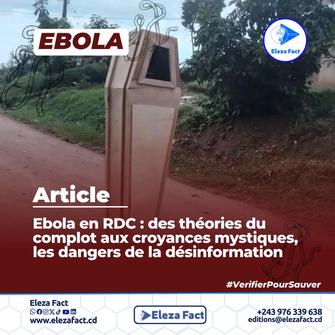
Ebola in DRC: from conspiracy theories to mystical beliefs, when health misinformation is amplified

Eleza Fact 29 mai 2026 French

Health authorities and journalists report a resurgence of Ebola in Ituri and surrounding regions, while widespread rumours and conspiracy theories undermine the response. Claims of mystical causes, political manipulation, or fabricated outbreaks circulate on social media, fueling distrust and encouraging people to avoid medical care. Field investigations dismiss myths such as the so‑called “mysterious coffin,” confirming instead the role of unsafe funerary practices in spreading the Bundibugyo variant. Experts from the WHO and national laboratories provide scientific confirmation of the outbreak through PCR testing and genomic sequencing. Violent reactions driven by misinformation disrupt treatment efforts, with attacks on isolation centres and patients fleeing care. Strengthening community engagement, transparent communication, and trust in scientific evidence is identified as essential to controlling the epidemic and countering harmful false narratives.
Ebola outbreak Health misinformation Public health crisis Democratic Republic of the Congo Ituri Goma Organisation mondiale de la Santé Africa CDC Institut national de recherche biomédicale Croix-Rouge Gouvernement de la RDC Ministère de la Santé de la RDC
Style rédactionnelInformatif

Mostly factual with analysis of misinformation and expert testimony
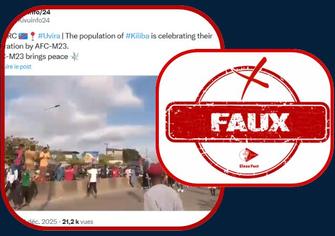
Attention, this video of a protest in Cameroon does not show the population of Kiliba celebrating the arrival of the AFC/M23

Eleza Fact 16 déc. 2025 French

A widely shared video claiming to show residents of Kiliba celebrating the arrival of AFC/M23 fighters was verified as originating from Douala, Cameroon, during post‑election protests in October 2025. Visual clues, Google Lens, Google Earth, and metadata analysis confirmed the footage was unrelated to events in South Kivu. The misleading clip was amplified across social media accounts, contributing to false narratives amid heightened insecurity in eastern DR Congo.

Misinformation Conflict in DR Congo Cameroon elections Cameroon Democratic Republic of the Congo South Kivu AFC/M23 FARDC UNICEF Les Dossiers de Franck 237showbiz Issa Tchiroma Bakary
Style rédactionnelFactuel

Fact-focused verification of misleading video

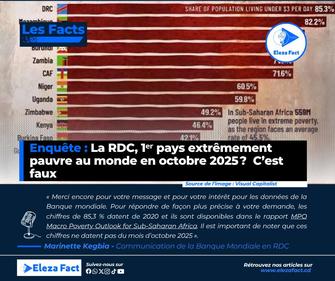
Investigation: Is the DRC the world's No. 1 extremely poor country in October 2025? This is false

Eleza Fact 31 oct. 2025 French

Multiple sources confirmed that no World Bank poverty ranking was published in October 2025, contradicting viral claims that the Democratic Republic of the Congo was classified as the world's most extremely poor country. The rumor originated from a Visual Capitalist graphic that misinterpreted outdated 2020 poverty data from Our World in Data. The World Bank, IMF, and national statistics authorities confirmed that while the DRC faces high poverty levels, current assessments place it around sixth or seventh globally, not first. Updated national surveys indicate nuanced socioeconomic trends, with improvements in some social indicators and ongoing severe challenges in others. The investigation underscores the importance of verifying sources, as misinformation can worsen public distrust amid economic and security instability.

Poverty statistics Misinformation on social media Economic situation in the DRC Fact-checking Democratic Republic of the Congo Sub-Saharan Africa Global World Bank International Monetary Fund Institut National de la Statistique (INS) Radio Okapi Rodriguez Katsuva
Style rédactionnelInformatif

Mostly factual reporting with analytical commentary about data validity and misinterpretation.

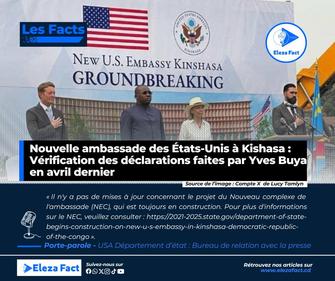
New U.S. Embassy in Kinshasa: Verification of Statements Made by a Congolese Journalist Last April

Eleza Fact 30 mai 2025 French

U.S. involvement in diplomatic mediation in eastern DRC has fueled speculation online, including viral false claims by journalist Yves Buya alleging that Donald Trump ordered Secretary of State Marco Rubio to accelerate construction of the new U.S. Embassy in Kinshasa and that the site would host agencies such as the CIA, the Department of Defense, and AFRICOM. A review of official documents and communications with the U.S. Department of State, the U.S. Embassy in Kinshasa, and Congolese authorities confirms that these assertions are unfounded. The only verified information derives from an August 2023 State Department press release announcing the launch of construction under the Biden administration, led by Ambassador Lucy Tamlyn. The project focuses on diplomatic modernization, with an investment estimated between 750 and 764 million dollars, contrary to the claimed one billion. No evidence supports the involvement of Trump or Rubio or the relocation of strategic U.S. security institutions to the embassy site, underscoring the need for rigorous verification amid widespread misinformation.

Misinformation U.S.–DRC Relations Diplomacy Democratic Republic of the Congo Kinshasa United States U.S. Department of State U.S. Embassy in Kinshasa AFRICOM CIA Presidency of the Democratic Republic of the Congo Ministry of Land Management of the DRC
Style rédactionnelFactuel

The text is a factual, evidence-based fact-check relying on official statements and documentation.

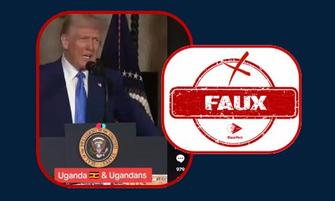
These videos of Donald Trump speaking about Uganda are the result of artificial manipulation

Eleza Fact 16 mai 2025 French

Multiple viral TikTok videos claiming to show Donald Trump addressing Ugandan military and political issues were proven to be digitally manipulated. The original footage comes from a February press conference with Benjamin Netanyahu focused solely on Gaza. Deepfake detection tools confirmed that the audio in the TikTok versions was artificially generated and unsynchronized with Trump's lip movements. Despite real recent U.S. policy decisions affecting Uganda—such as suspension of foreign aid programs and reduced USAID contracts—none pertain to military or political intervention. The findings highlight the prevalence of AI-generated misinformation and the need for careful verification of online content.

Disinformation Deepfakes Donald Trump Uganda United States Gaza United States government USAID PEPFAR Euronews Radio France Internationale Benyamin Nétanyahou
Style rédactionnelFactuel

The text is a factual verification report relying on evidence, tool analyses and source comparison.

Recruter Message
×

Inscrivez-vous pour envoyer un message à Joël

Vous avez déjà un compte ? Se connecter
Vous cherchez du travail ? S'inscrire en tant que journaliste
Vérifiez votre e-mail pour finaliser l'inscription
Nous venons d'envoyer un e-mail à . Veuillez consulter votre boîte de réception et cliquer sur le lien pour vérifier votre adresse e-mail et finaliser votre inscription. Si vous ne voyez pas l'e-mail, pensez à vérifier votre dossier spam ou courrier indésirable.
Vous n'avez pas reçu l'e-mail ?

Inscrivez-vous pour débloquer les profils

Vous avez déjà un compte ? Se connecter
Vous cherchez du travail ? S'inscrire en tant que journaliste
Vérifiez votre e-mail pour finaliser l'inscription
Nous venons d'envoyer un e-mail à . Veuillez consulter votre boîte de réception et cliquer sur le lien pour vérifier votre adresse e-mail et finaliser votre inscription. Si vous ne voyez pas l'e-mail, pensez à vérifier votre dossier spam ou courrier indésirable.
Vous n'avez pas reçu l'e-mail ?