Noah Moeys
Arequipa, Peru
- Usually responds
- Within a few hours
Noah Moeys is an investigative journalist and foreign correspondent currently situated in Arequipa, Peru. She launched her freelance career in The Guardian. Since then she has focused on investigative journalism, publish…
Seen in The Guardian, Groene, FD.nl
'They are all corrupt'
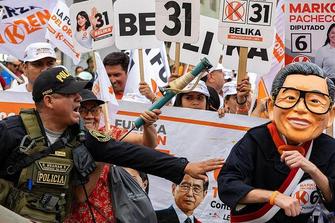
Peru is heading into a presidential election — its tenth president in a decade — marked by deep public disillusionment. A Latinobarómetro survey finds only around 7% of Peruvians trust their political institutions, the lowest in South America. Four former presidents are imprisoned for corruption, one died in jail, another committed suicide to avoid incarceration, and a special prison for ex-presidents has been built. Daily murders have doubled to six per day, and widespread extortion plagues urban areas. Against this backdrop, 51% of Peruvians reportedly want a leader modelled on El Salvador's Nayib Bukele. The frontrunner, Keiko Fujimori, pledges to govern "with a firm hand" and continue her father's authoritarian legacy. Far-right candidate Rafael López Aliaga, polling second, proposes the death penalty for minor crimes and mass deportation of Venezuelans. Despite 35 candidates and six nights of televised debates, political reporter Martin Riepl dismisses the process as a "clownish circus" of populist promises. Paradoxically, Peru boasts one of Latin America's fastest-growing economies — Goldman Sachs forecasts 3.1% GDP growth — underpinned by an independent central bank, open trade policy and high copper and gold prices. Former economy minister Luis Miguel Castilla warns this "decoupling" of politics and economics is reaching its limits, with quality investors deterred and no long-term policy possible under such instability. Ordinary Peruvians, from a former professional footballer in a remote coastal village to an Andean smallholder without running water, have largely given up on the state and resigned themselves to self-reliance.
Sinking Dutchman: world’s largest historical sailing fleet threatened by Covid-19
Covid-19 restrictions have left the Netherlands’ historic sailing fleet facing existential financial pressures, with most of the 400 vessels unable to operate due to distancing rules that make crew teamwork and overnight trips impossible. Skippers such as Sven Timmann report catastrophic revenue losses, mounting maintenance costs, and looming certificate-renewal expenses that could force ships to be rebuilt to modern standards. Limited government aid has fallen far short of needs, and upcoming policy discussions are scheduled too late to prevent bankruptcies already beginning within the sector. Industry representatives warn that without urgent support, vessels may be seized and demolished, threatening the survival of Dutch maritime heritage and the livelihoods tied to it.