 Recruter maintenant
 Envoyer un message à Victoria
Langues
abkhaze
anglais
italien
espagnol
Vous voulez un profil comme celui-ci ?
Rejoignez des milliers de professionnels des médias qui utilisent journalist.net pour présenter leur travail et être recrutés par les plus grands médias.
Commencer
Découvrez comment ça marche
Connectez-vous via Journalist.net
1
Professionnels vérifiés
Chaque journaliste sur cette plateforme a été vérifié manuellement par notre équipe à Londres. Vous échangez avec un professionnel des médias confirmé.2
Engagement protégé
Nous protégeons les coordonnées des journalistes et fournissons une couverture d'assurance pour toutes les réservations. Les deux parties travaillent en toute confiance et sécurité.3
Paiement sécurisé
Les paiements sont conservés sous séquestre et libérés à la livraison du travail. Le paiement des journalistes est garanti ; les clients approuvent avant que les fonds ne soient finalisés.Vous avez encore des questions ?
Consulter la FAQAbout Victoria
Journaliste freelance

Couverture médiatique, actualités de dernière minute et reportages.
Rédactrice, photo- et vidéojournaliste.

Victoria Herranz (Espagne. 1983) journaliste visuelle freelance espagnole axée sur le documentaire et le photojournalisme.

Elle a travaillé, en tant que freelance, pour des agences de presse internationales. Ses photos ont été publiées dans des journaux, des magazines et des blogs. Elle est également rédactrice et contributrice pour plusieurs médias (articles et interviews sur le journalisme, la science, l'anthropologie et les droits des femmes)

Victoria Herranz combine son travail de documentariste et de photojournaliste avec l'écriture et la réalisation de films.
Portfolio
IN ANOTHER PLACE
In Another Place is a multimedia project and an anthropological research about the effects of hard drug usage and its rehabilitation in Spain.
This first part was photographed inside a Therapeutic Community for the rehabilitation of drug addicts.
The rehabilitation period last between 6 -12 months and the patients are only allowed out two times in this rehabilitation period to visit their families. The patient can dropout of the center before of finishing the treatment but always on their own responsibility for doing so. As a means of maintaining a clean transition after patient finishes his treatment in the community he must continue his social rehabilitation through programs run by their local city or town of residence.
The photographer lived among the men only patients and nurses to document this story.
First Prize Ethnographic Cinema and Photography MAAM
©Victoria Herranz
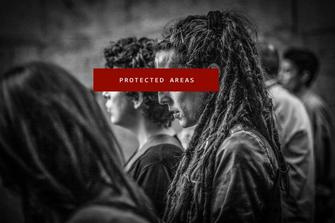
PROTECTED AREAS
Can a government decide over the woman body?
Protected Areas explores the reaction to the spanish government’s propose to modified to change the abortion law for part of women than see limited their rights. Protected Areas is also a multimedia about the analogy between the woman body and the public area, it’s proposes the metaphoric relation between both than struggle area for the politic and ideologic dominant powers in the actual spanish society.
“The fact that a bill on abortion is proposed in 2014 in Spain after certain vested rights on voluntary termination of pregnancy taken for granted makes us think that what is private is actually defined by what is public.... Turning back to such an important debate and call into question the vested rights on voluntary termination of pregnancy have a violent component to the extent that makes more precarious the existence of women, who obviously are affected, not only by the possible law, even by the debate itself.” -