Hire journalists

Publishers & Broadcasters Content Marketing Teams PR & Comms Teams Risk & Intelligence Teams Find journalists Media Monitoring Pricing

For journalists

Journalism jobs Pay rates Create your free profile

About Waleed

I am Waleed Mohammed, a video journalist from Sudan. I worked for a number of news websites, news agencies and satellite channels. I am good at both photography and editing. If you need materials from Sudan, please contact me Contact number: ****

Languages
English Arabic
Seen in
Activerain Mdpi

Work 5

The Influence of Nanocoatings on the Wear, Corrosion, and Erosion Properties of AISI 304 and AISI 316L Stainless Steels: A Critical Review Regarding Hydro Turbines

Corrosion and Materials Degradation 7 Feb 2025 English

The review examines failures affecting hydro turbine blades, including sediment erosion, cavitation, erosion–corrosion, and fatigue, with particular attention to AISI 304 and AISI 316L stainless steels. It compares coating technologies such as HVOF, HVAF, plasma spraying, laser surface modification, PVD, and CVD, and finds that nanostructured coatings generally provide better hardness, adhesion, wear resistance, corrosion protection, and cavitation resistance than conventional coatings. WC-based cermets, alumina–titania, aluminide, TiN, Ti–SiC, NiTi–ZrO₂, and chromium nitride systems are reviewed for turbine repair and protection. The authors recommend further development and testing of multilayer or composite coatings combining nano-alumina and titanium carbide to extend turbine component life, increase overhaul intervals, and reduce repair costs.

Nanocoatings Hydro Turbines Stainless Steel Wear and Corrosion Erosion and Cavitation Renewable Energy Iraq Russia Iran RUDN University Iraqi Ministry of Electricity Sharif University of Technology
Reporting styleInformative

Predominantly evidence-based technical review, with evaluative comparisons and recommendations for future coating research.
Requirements for NYS Real Estate License?

ActiveRain 19 May 2023 English

The article outlines the steps required to obtain a New York State Real Estate License, including submitting an application, completing 77 hours of approved education, passing the NYS Real Estate Salesperson examination, being sponsored by a licensed broker, and having a current NYS photo ID. It also mentions additional requirements such as fingerprinting. The article aims to guide aspiring real estate agents through the licensing process.

Real Estate Licensing New York State Department of State
Reporting styleInformative

Informative with some guidance and encouragement

How to Get an Aerial View of New York City

ActiveRain 25 Aug 2022 English

Helicopter tours offer a unique and efficient way to experience New York City, providing aerial views of major landmarks and avoiding the city's notorious traffic. This option is particularly appealing for those with limited time, allowing them to see the entire city in just 20-30 minutes.

Travel Tourism New York City Helicopter Tour
Reporting styleInterpretive

The text is mostly opinion-based, promoting the benefits of helicopter tours over other forms of city tours.

akhbaralaan.net

Link Akhbaralaan

Where Can Aluminum Go When Batteries Die?

Advanced Science English

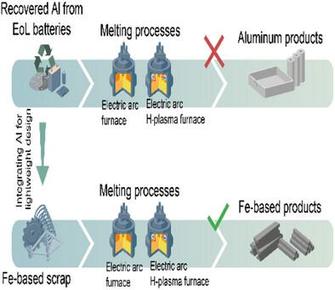
Recycling aluminum from end-of-life EV lithium‑ion batteries is hindered by oxide contamination and intermetallic formation, which make direct remelting impractical. Hydrogen plasma reduction fails to remove alumina effectively, yielding brittle, impure ingots. A dissimilar recycling route is demonstrated by integrating battery‑derived Al scrap into Fe‑based alloys, producing duplex austenite/ferrite steels with 8 wt% and 12 wt% Al. The 8 wt% alloy achieves a balance of strength and ductility (YS ≈ 407 MPa, UTS ≈ 665 MPa, elongation ≈ 32%) via TRIP from metastable austenite, while the 12 wt% alloy is stronger but brittle due to extensive ferrite and coarsened B2 (NiAl‑rich) precipitates that localize stress and promote cracking. Atom‑probe and EBSD analyses show phase partitioning and minor Mn/Si interfacial segregation, with impurity levels tolerable for processing. Scrap‑based Fe‑Al production can reduce energy use by about 82–85% and CO2 emissions by about 85–89% relative to ore‑based routes. The approach is compatible with EAF/induction melting and can be industrialized with preprocessing and feedstock control, offering a scalable pathway to decarbonize ferrous metallurgy while valorizing contaminated Al scrap.

Battery Recycling Electric Vehicles Sustainability Metals Industry Circular Economy European Union Germany South Korea Won-Hyoung Lee Dennis Klapproth Christian Broß Uwe Tezins
Reporting styleFactual

Peer‑reviewed experimental study with detailed methods, data, and analysis; minimal subjective language.

Other journalists in Khartoum

Hire Message
×

Sign up to message Waleed

Already have an account? Log in
Looking for work? Register as a Journalist
Verify your email to complete registration
We’ve just sent an email to . Please check your inbox and click the link to verify your email address and complete your registration. If you don’t see the email, be sure to check your spam or junk folder.
Didn’t receive the email?

Sign up to unlock profiles

Already have an account? Log in
Looking for work? Register as a Journalist
Verify your email to complete registration
We’ve just sent an email to . Please check your inbox and click the link to verify your email address and complete your registration. If you don’t see the email, be sure to check your spam or junk folder.
Didn’t receive the email?