Engager des journalistes

Éditeurs et diffuseurs Équipes de marketing de contenu Équipes RP et communication Équipes risques et renseignement Trouver des journalistes Veille médias Tarifs

Pour les journalistes

Offres d'emploi en journalisme Tarifs Créez votre profil gratuit

À propos de Waleed

Je suis Waleed Mohammed, vidéojournaliste originaire du Soudan. J'ai travaillé pour plusieurs sites d'information, agences de presse et chaînes satellitaires. Je maîtrise à la fois la photographie et le montage. Si vous avez besoin de matériel provenant du Soudan, veuillez me contacter Numéro de contact : ****

Langues
anglais arabe
Vu dans
Activerain Mdpi

Travaux 5

The Influence of Nanocoatings on the Wear, Corrosion, and Erosion Properties of AISI 304 and AISI 316L Stainless Steels: A Critical Review Regarding Hydro Turbines

Corrosion and Materials Degradation 7 févr. 2025 English

The review examines failures affecting hydro turbine blades, including sediment erosion, cavitation, erosion–corrosion, and fatigue, with particular attention to AISI 304 and AISI 316L stainless steels. It compares coating technologies such as HVOF, HVAF, plasma spraying, laser surface modification, PVD, and CVD, and finds that nanostructured coatings generally provide better hardness, adhesion, wear resistance, corrosion protection, and cavitation resistance than conventional coatings. WC-based cermets, alumina–titania, aluminide, TiN, Ti–SiC, NiTi–ZrO₂, and chromium nitride systems are reviewed for turbine repair and protection. The authors recommend further development and testing of multilayer or composite coatings combining nano-alumina and titanium carbide to extend turbine component life, increase overhaul intervals, and reduce repair costs.

Nanocoatings Hydro Turbines Stainless Steel Wear and Corrosion Erosion and Cavitation Renewable Energy Iraq Russia Iran RUDN University Iraqi Ministry of Electricity Sharif University of Technology
Style rédactionnelInformatif

Predominantly evidence-based technical review, with evaluative comparisons and recommendations for future coating research.
Requirements for NYS Real Estate License?

ActiveRain 19 mai 2023 English

The article outlines the steps required to obtain a New York State Real Estate License, including submitting an application, completing 77 hours of approved education, passing the NYS Real Estate Salesperson examination, being sponsored by a licensed broker, and having a current NYS photo ID. It also mentions additional requirements such as fingerprinting. The article aims to guide aspiring real estate agents through the licensing process.

Real Estate Licensing New York State Department of State
Style rédactionnelInformatif

Informative with some guidance and encouragement

How to Get an Aerial View of New York City

ActiveRain 25 août 2022 English

Helicopter tours offer a unique and efficient way to experience New York City, providing aerial views of major landmarks and avoiding the city's notorious traffic. This option is particularly appealing for those with limited time, allowing them to see the entire city in just 20-30 minutes.

Travel Tourism New York City Helicopter Tour
Style rédactionnelInterprétatif

The text is mostly opinion-based, promoting the benefits of helicopter tours over other forms of city tours.

akhbaralaan.net

Lien Akhbaralaan

Where Can Aluminum Go When Batteries Die?

Advanced Science English

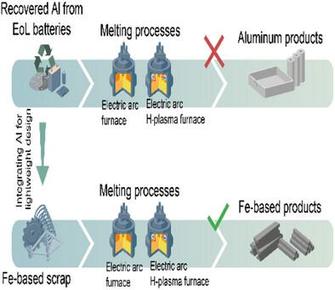
Recycling aluminum from end-of-life EV lithium‑ion batteries is hindered by oxide contamination and intermetallic formation, which make direct remelting impractical. Hydrogen plasma reduction fails to remove alumina effectively, yielding brittle, impure ingots. A dissimilar recycling route is demonstrated by integrating battery‑derived Al scrap into Fe‑based alloys, producing duplex austenite/ferrite steels with 8 wt% and 12 wt% Al. The 8 wt% alloy achieves a balance of strength and ductility (YS ≈ 407 MPa, UTS ≈ 665 MPa, elongation ≈ 32%) via TRIP from metastable austenite, while the 12 wt% alloy is stronger but brittle due to extensive ferrite and coarsened B2 (NiAl‑rich) precipitates that localize stress and promote cracking. Atom‑probe and EBSD analyses show phase partitioning and minor Mn/Si interfacial segregation, with impurity levels tolerable for processing. Scrap‑based Fe‑Al production can reduce energy use by about 82–85% and CO2 emissions by about 85–89% relative to ore‑based routes. The approach is compatible with EAF/induction melting and can be industrialized with preprocessing and feedstock control, offering a scalable pathway to decarbonize ferrous metallurgy while valorizing contaminated Al scrap.

Battery Recycling Electric Vehicles Sustainability Metals Industry Circular Economy European Union Germany South Korea Won-Hyoung Lee Dennis Klapproth Christian Broß Uwe Tezins
Style rédactionnelFactuel

Peer‑reviewed experimental study with detailed methods, data, and analysis; minimal subjective language.

Recruter Message
×

Inscrivez-vous pour envoyer un message à Waleed

Vous avez déjà un compte ? Se connecter
Vous cherchez du travail ? S'inscrire en tant que journaliste
Vérifiez votre e-mail pour finaliser l'inscription
Nous venons d'envoyer un e-mail à . Veuillez consulter votre boîte de réception et cliquer sur le lien pour vérifier votre adresse e-mail et finaliser votre inscription. Si vous ne voyez pas l'e-mail, pensez à vérifier votre dossier spam ou courrier indésirable.
Vous n'avez pas reçu l'e-mail ?

Inscrivez-vous pour débloquer les profils

Vous avez déjà un compte ? Se connecter
Vous cherchez du travail ? S'inscrire en tant que journaliste
Vérifiez votre e-mail pour finaliser l'inscription
Nous venons d'envoyer un e-mail à . Veuillez consulter votre boîte de réception et cliquer sur le lien pour vérifier votre adresse e-mail et finaliser votre inscription. Si vous ne voyez pas l'e-mail, pensez à vérifier votre dossier spam ou courrier indésirable.
Vous n'avez pas reçu l'e-mail ?