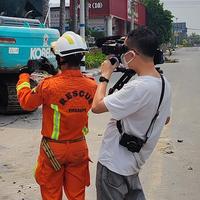
Pratch Rujivanarom é um jornalista investigativo baseado em Banguecoque, Tailândia.
Desde que Pratch começou a trabalhar como repórter ambiental no jornal The Nation em 2015, ele tem estado profundamente envolvido na cobertura ambiental e climática não apenas na Tailândia, mas na mais ampla Região do Mekong.
Embora sua especialidade principal sejam temas ambientais, ele também cobre regularmente saúde pública, direitos humanos e educação.
Ao longo de sua trajetória na carreira jornalística, ele produziu muitas reportagens investigativas aprofundadas que foram publicadas em veículos de grande circulação tanto na Tailândia quanto internacionalmente, como Bangkok Post, Mekong Eye e China Dialogue.
Ele também foi treinado em jornalismo de dados e tem experiência na produção de podcasts.
Bangkok PostDialogue EarthMekong EyeNationthailandThethaigerChinadialogueBenarnewsEco Business
Trabalhos 84
New steel plant is early test for Argentina’s big investment scheme
Dialogue Earth23 out. 2026English
Sidersa is building a USD 300 million steel plant in San Nicolás, expected to begin production in 2028 and create hundreds of direct jobs. Its electric-arc-furnace process could cut emissions substantially compared with conventional coal-based steelmaking, but the plant’s actual footprint will depend on access to cleaner electricity and adequate scrap metal. Argentina’s saturated grid, uncertain domestic demand, scrap-supply challenges and environmental disputes complicate the project’s prospects. The plant is the first industrial project approved under the Rigi investment-incentive scheme, which critics say offers major benefits without firm requirements on environmental safeguards, local sourcing, production or jobs. Its success will test both the commercial viability of lower-emissions steel in Argentina and the effectiveness of the investment framework.
Steel IndustryGreen SteelIndustrial DecarbonisationRenewable EnergyArgentina’s Investment IncentivesEnvironmental RegulationArgentinaSan Nicolás de los ArroyosEuropean UnionFundarUnited for Life and the EnvironmentInter-American Development Bank
Estilo de reportagemEquilibrado
Mostly reported analysis, with some evaluative framing and quoted expert judgments about the project’s prospects.
OpinativoFactual
Mexico’s Year of Oil Spills Fuels Growing Concern
Dialogue Earth22 out. 2026English
Oil spills across Mexico in 2026 have damaged Gulf and Pacific coast communities, undermining fishing livelihoods and raising fears about contamination and harm to wildlife. A February spill was traced by the government to a leaking pipeline at Pemex’s offshore Abkatun field; fishers report steep price declines, damaged equipment and uneven access to compensation. Data obtained by Dialogue Earth shows substantial discrepancies between Pemex spill figures reported to financial regulators, in company sustainability reports and in environmental agency records. Community groups have mapped more than 100 contamination sites, while researchers warn that ecological effects, including impacts on turtles, reefs and food chains, may persist for years. Authorities have reported cleanup efforts but have not released a full assessment or detailed restoration plans, prompting calls for stronger oversight, remediation and fair support for affected residents.
Oil SpillsEnvironmental PollutionMarine EcosystemsFisheries and LivelihoodsCorporate AccountabilityClimate ChangeMexicoGulf of MexicoVeracruzMexican governmentGulf of Mexico Reef Corridor Network (RCAGM)National Autonomous University of Mexico (UNAM)
Estilo de reportagemInterpretativo
Primarily reported with data and attributed claims, but adopts a critical framing of Pemex's spill reporting, environmental oversight and impacts on local communities.
OpinativoFactual
Back to the Future: The Abundance and Scarcity of a Remade 2056
Dialogue Earth21 out. 2026English
Li Yan imagines life in 2056 through Ami, an 18-year-old celebrating Gaia Day in a world transformed by climate disruption. Cheap clean energy, AI, resilient infrastructure and planetary sensor networks help reduce emissions and manage disasters, while severe climate impacts, mineral and water shortages, and unequal access to technology persist. The imagined future also brings new financial mechanisms such as the Carbon Coin and tensions between technological expansion, conservation and social equity. The essay argues that climate adaptation and technological change must be accompanied by a deeper cultural shift toward ecological values, cooperation and a renewed understanding of humanity's relationship with the planet.
Speculative, reflective essay presenting a possible future and advocating new ecological values and international cooperation.
OpinativoFactual
Without USAID, Guatemala’s Maya Reserve Must Support Itself
Dialogue Earth21 out. 2026English
The Maya Biosphere Reserve’s community concessions have protected large areas of Guatemalan forest through sustainable harvesting, restoration and fire prevention, with USAID support playing a central role for decades. The Trump administration’s 2025 freeze of most USAID assistance has cut funding for patrols, restoration and community projects just as fire risks and cattle-ranching encroachment intensify. Carmelita’s diversified timber, honey, palm-leaf, chicle and tourism income has made it relatively self-sustaining, while less-established concessions such as Aficc face steep reductions in restoration work. A first payment from the GuateCarbon REDD+ project has helped communities, but delayed sales and the need to find ongoing credit buyers limit its reliability. The future of the reserve depends on whether its communities can build durable sources of income and conservation finance without a major external funder.
Forest ConservationCommunity ForestryUSAID Funding CutsWildfiresSustainable LivelihoodsCarbon MarketsPetén, GuatemalaMaya Biosphere ReserveUnited StatesUnited States Agency for International Development (USAID)National Council of Protected Areas (Conap)Petén Forest Communities Association (Acofop)
Estilo de reportagemInformativo
Primarily reported and attributed, with some framing that emphasizes the risks and uncertainty created by funding cuts.
OpinativoFactual
Antarctic letters: ‘We care about the same issue’
Dialogue Earth20 out. 2026English
Chilean expert Giovannina Sutherland and Chinese researcher Jiliang Chen discuss negotiations over a proposed marine protected area in the West Antarctic Peninsula and management of the region’s krill fishery. Sutherland says China’s insistence on science-based restrictions, time-limited protected areas and revisions to CCAMLR rules has contributed to stalled talks, though she suggests China may be preparing its own proposal. Chen argues members already share ground on linking the protected area with krill management and adopting interim safeguards. He urges proponents to negotiate collectively and says China should soon offer more specific ideas. The exchange reflects hopes that a team-based approach can help CCAMLR reach consensus.
Antarctic Marine ConservationMarine Protected AreasKrill FisheriesInternational Environmental NegotiationsAntarcticaChinaChileCommission for the Conservation of Antarctic Marine Living Resources (CCAMLR)ArgentinaInstitute for Marine and Antarctic StudiesGiovannina SutherlandJiliang Chen
Estilo de reportagemEquilibrado
An expert exchange presents differing interpretations of conservation and fisheries policy, alongside advocacy for building consensus.
OpinativoFactual
Concerns raised as data centres go underwater in China
Dialogue Earth15 out. 2026English
China is rapidly expanding data-centre capacity, and underwater facilities are being promoted as a way to reduce cooling-related electricity and freshwater use while drawing on offshore wind power. The Lingang project claims substantial energy savings and uses no freshwater for cooling, but experts say evidence about environmental effects remains limited. Warmer discharge water could affect organisms near intake and outflow pipes, while anti-fouling coatings may create pollution risks. Researchers also point to gaps in long-term impact assessments and industry disclosure. High maintenance costs, equipment replacement, and vulnerability to typhoons and cable damage could hinder commercial viability, although underwater centres may complement land-based facilities and make better use of renewable energy.
Underwater Data CentresEnvironmental ImpactRenewable EnergyMarine EcosystemsArtificial IntelligenceChinaShanghaiHainanDalian University of TechnologyBeijing Institute of TechnologyChina Sustainable Development and Marine Economy InstitutePlymouth Marine Laboratory
Estilo de reportagemInformativo
Primarily factual reporting with attributed expert views and some cautionary framing about environmental risks.
OpinativoFactual
‘Where Is Our Forest?’ The Malaysian Youths Turning Climate Anxiety into Legal Action
Dialogue Earth15 out. 2026English
Amira Aliya and five other young Malaysians have filed a judicial review against the government, seeking enforcement of its long-standing pledge to keep at least half the country’s land under forest cover and an end to deforestation. They argue that failing to protect forests violates legal principles and constitutional rights, including equality and the right to life, and that the harm falls unfairly on younger and future generations. A RimbaWatch report estimates that planned land conversions could reduce forest cover below 50%, while differing from the government’s higher estimate partly because it excludes plantations from its definition of forest. The case faces an October leave hearing that will determine whether the applicants have legal standing. The campaign also offers young people a way to channel eco-anxiety into collective action.
Climate ChangeDeforestationEnvironmental LawYouth Climate ActivismEco-AnxietyIntergenerational JusticeMalaysiaJohorKuala LumpurMalaysian governmentMalaysia's Ministry of Natural Resources and Environmental SustainabilityMalaysian Bar Council
Estilo de reportagemInterpretativo
The article is mainly reported, but foregrounds young activists’ concerns and uses evaluative framing around deforestation and legal rulings.
OpinativoFactual
Brazil Rare Earth Deal Proves Militaries’ Long-Held Interest in Minerals
Dialogue Earth14 out. 2026English
A US Department of War investment of $750 million in Brazil’s Serra Verde rare-earth mine highlights how military supply needs are increasingly intertwined with minerals sought for the energy transition. China’s dominance in rare-earth processing creates a strategic vulnerability for Washington and puts Latin American governments under pressure to balance US security demands with ties to China. Environmental advocates warn that military demand could intensify mining impacts, divert minerals from climate-related uses, and make demand forecasts inadequate. Brazil’s new critical-min minerals strategy aims to expand domestic manufacturing and processing, but the country must develop downstream capacity to gain industrial sovereignty rather than remain an extraction site. Experts and advocacy groups call for stronger regulation and international cooperation.
Critical MineralsRare Earth ElementsMilitary Supply ChainsEnergy TransitionUS-China Geopolitical CompetitionMining and Environmental ImpactsBrazilian Industrial PolicyBrazilUnited StatesLatin AmericaUS Department of WarGovernment of Brazil
Estilo de reportagemEquilibrado
Analytical and reported, but uses evaluative language to emphasize the risks of military-driven mineral demand and extractivism.
OpinativoFactual
Contexto políticoCentro-esquerda
Critically examines US military and geopolitical influence and extractivism, while focusing on environmental protection and resource sovereignty rather than party politics.
Extrema-esquerdaExtrema-direita
Offshore wind offers China much more than carbon cutting
Dialogue Earth7 set. 2026English
China’s offshore wind capacity could expand from roughly 47 GW to 100 GW by 2030 and potentially reach 1,000 GW by 2050. Modelling suggests that large-scale deployment would help coastal provinces become net electricity exporters, improve energy self-sufficiency, create millions of job-years and reduce the need for long-distance transmission and energy storage. The shift could reduce investment and electricity exports from inland regions such as Inner Mongolia, however. Achieving the most ambitious pathway would require stronger post-2030 targets, coordination between offshore development and transmission planning, power-market reforms that enable interprovincial electricity trading, and continued growth in electricity demand.
Offshore WindRenewable EnergyChina’s Energy TransitionEnergy SecurityElectricity Grid PlanningDecarbonizationEmployment and Regional InvestmentChinaCoastal ChinaInner MongoliaNational Renewable Energy LaboratoryGridPath
Estilo de reportagemInformativo
Evidence-based analysis using power-system modelling, with an argument for more ambitious offshore wind deployment.
OpinativoFactual
How Long Until China Can Electrify Its Heavy Trucks?
Dialogue Earth7 set. 2026English
China’s heavy-truck sector is beginning to electrify rapidly, with alternative-fuel trucks reaching about 28% of new sales in 2025 despite representing only 4.5% of the total fleet. Government subsidies, trade-in schemes and infrastructure plans aim to raise market penetration to 40% and put 1.6 million electric trucks on the road by 2030, a target analysts consider achievable or conservative. Battery swapping is useful for fixed industrial routes, while conventional charging remains more flexible but requires major network expansion. Hydrogen trucks face higher fuel costs and limited refuelling infrastructure. High vehicle and station costs remain significant barriers, but electrification could reduce pollution, oil demand and create new industrial opportunities in truck-manufacturing centres such as Shiyan.
Heavy Truck ElectrificationTransport DecarbonizationElectric VehiclesHydrogen FuelAir PollutionEnergy TransitionChinaShiyanBeijing-Tianjin-HebeiChina's Ministry of TransportState Council of the People's Republic of ChinaEmber
Estilo de reportagemInformativo
Primarily fact-based reporting and analysis, with some personal observations and hopeful commentary from the author.
Respeitamos sua privacidade e usamos um número limitado de cookies para fornecer funcionalidades essenciais e aprimorar sua visita. Nenhum cookie de publicidade de terceiros está envolvido. Para mais detalhes, leia nossa Política de Cookies.